Acid Ranch
The Great Houdini Wasn’t So Great
2007, Record Company Records
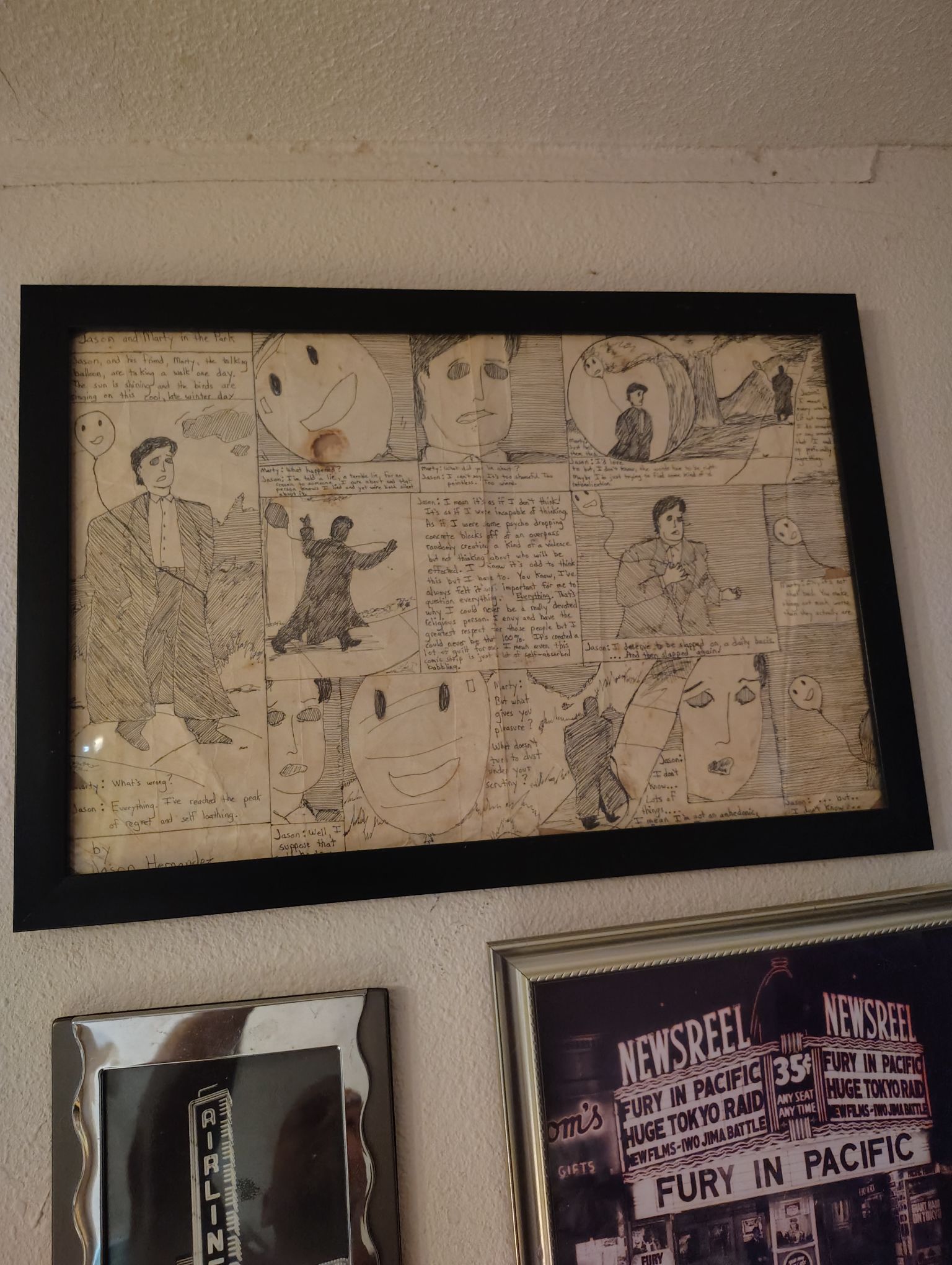
Framed on the wall in my living room is an awful 12″x18″ comic strip that I drew for high school art class in 1993.
In it, I’m walking with my friend, Marty, the Talking Balloon, who floats next to me on a string. He’s a non-judgmental, captive, literally brainless audience for the self-centered thoughts in my clueless teenage head and, boy, do I let rip.
Marty responds by questioning me like I’m fascinating because that’s what you crave when you’re a kid.
Every inch of this rotting piece of paper is devoted to 16-year-old me blabbing about how I do everything wrong, no one likes me, and I don’t know how to fix it. THE END.
It’s junk, but I love the artwork. Past kindergarten, I’ve never drawn much. I still don’t draw or have a feel for how to express anything by doing it. Envy is a useless emotion and I want nothing to do with it, but if I’m envious of anyone on Earth it’s of people who draw well. That’s one of the freakiest talents to me. It’s so interesting because it’s something that one preserves from childhood. Every kid draws. A select few of us never lose that and do beautiful things with it.
At age 48, that childhood passion for drawing has been beaten right out of my old ass. I’m too hooked on words these days.
But the 16-year-old me drew the hell out of this comic. I put some primitive effort into the details. Its compositions sing. Its lines put across a mood. Its lines are everywhere. It’s been over thirty years and I don’t remember much about making it, but I can tell that I worked hard on it. I love it, even though it sucks.
I hang it up high on the wall, so that nobody can read the words. That’s the joke I always make when someone stops to look at it, but it’s true.
What I’m getting at is that I think I understand why Robert Pollard released three albums of his early 1980s basement tapes, made when he was young and writing his brains out for a project called Acid Ranch. a band he formed with Jim Pollard and Mitch Mitchell. I think that Pollard loves this energetic goofball who howls poetry into cheap tape recorders and over drum-less guitar plunks and blasts of noise. It wasn’t made to be heard by anyone. Acid Ranch didn’t play live and nobody sent any tapes to record labels.
Acid Ranch have ONE ambition and that’s to find themselves.
The young singer and wordsmith on this record is REALLY trying and he’s no hack. This Robert Pollard is a total weirdo, climbing up the psychedelic mountain and wandering, wandering, wandering. The mist never lifts. The trails never stop.
The limited, vinyl-only release (500 copies) is Pollard’s way of “hanging it up high”.
He wants you to hear it.
But he also doesn’t want you to hear it.
Or at least he wants the right people to hear it because not everyone is going to understand why this exists at all
I get that.
In Indiana Jones movies, ancient cultures are always hiding their artifacts behind meticulous death traps. Poison darts that shoot out when you get near to their idol. Walls that suddenly close in. Floors that give way when you step on them. They WANT to make it hard for a person to get this thing that they regard as sacred.
Robert Pollard does that in a way, but through these limited vinyl releases.
Yes, you can still hear the music on the internet, but if you want the actual Acid Ranch vinyl years after it sold out (and it sold out fast), you’re gonna need to outrun a giant, rolling boulder for it.

So, The Great Houdini Wasn’t So Great.
First, we admire the front cover. I believe it’s from the wedding when Kevin Fennell, proud in a tasteful grey tuxedo, married Bob’s sister, but don’t quote me on that. Bob wears a bitchin’ bolo tie and looks like he could be writing “A Portrait Destroyed by Fire” in his head. In the center is the elder Pollard, Bob’s father, I believe, toting liquor and a cig, like every adult did at family gatherings once upon a time.
The three Acid Ranch records aren’t too different from each other sonically, but they at least all look distinct. We’ve gone from collage art to a crazy silkscreen project to something spotted in an old family photo album and chosen for immortality. It’s a cousin (or maybe a brother-in-law) to the Kid Marine sleeve art.
As for the music, you know what’s up if you’ve heard the previous two Acid Ranch records. This is Robert Pollard in his twenties searching for songs and not finding many, but still making a bunch of noise, bless him.
With young artists, you can usually hear who they’re trying to be in their work. Their influences are obvious.
Notable about Acid Ranch is that there’s very little Pete Townsend here, or Peter Gabriel, or anyone British, for that matter. Acid Ranch explores an American brand of fucked-upness. Who is Pollard trying to BE here?
I hear Captain Beefheart and “Country” Joe McDonald. A little Fugs.
You could argue that some Wire post-punk shows up in “Pure Hot Tar” and “The Invincible Dart Throwing Competition” and you’d have a point, but tilt your head sideways and you can hear After Bathing at Baxter’s in them, too.
Best track: ‘Lie to the Rainbow”, a pretty one sung in “melody smoke” style (few words, just a mumbled tune). I wonder if Pollard himself was surprised to find it because he’s about to reuse it on his next record, Silverfish Trivia.
Second best track: “The Pain Stakes*, recommended for fans of moody psych. It comes off like a Thirteenth Floor Elevators demo from a day that the electric jug player and the drummer both got too high to show up.
Best song title (because that matters): “I’m Talkin’ Brotherly Love and You Set My Hand on Fire”. It’s a quote from a famous deleted scene from the movie Billy Jack. (Okay, I made that up.)
Weirdest track: “Comp No. X” has my heart. Rudimentary guitar abuse and a twinkling toy xylophone are sometimes just the thing to soothe your soul. Some might say that it shouldn’t exist. Me, I wish it was longer.
In conclusion, Acid Ranch are out of their minds and out of sync, but never out of breath and never out of ideas. Pollard’s songwriting would advance hundreds of miles from this stuff in time, but you can hear a manic energy in it that still courses through his work today.
You will never totally understand Acid Ranch because Acid Ranch isn’t a band who does things that a band normally does to be understood.
They’re that weird phase of your youth when you’re on some trip that baffles you later.
Put a frame around it and the mess starts to mean something.
And then hang it up high.
(PS: I don’t want to do this, but this article won’t feel complete to me until I share the high school comic strip that I teased at the beginning. Here it is. The camera shot is deliberately graceless. The comic is stupid. I was 16. The great high school thinker wasn’t so great. I still love walking by this whiff of nostalgia everyday, though.)